"Sometimes, let the world of flames speak / for itself."
- Jan Beatty, Dragstripping (2024)
A primary byproduct of ore-smelting is the mixture of oxides and silicon dioxide known as slag. Heaped into giant conical mountains alongside industrial sites, these otherworldly piles are known as slag heaps. Appearing as granulated pyramids of blast furnace refuse, slag heaps can include an assortment of copper, nickel, and zinc removed as non-ferrous material during the refinement of what will become steel. For those raised in industrial regions, such as Pittsburgh, slag heaps were once a common site along rivers such as the Monongahela, Allegheny, and Ohio. These sooty remnants of the Jones & Laughlin Steel Corporation or the Carrie Blast Furnaces are the height of the great Indian mounds that dotted this landscape centuries ago, but rather than a verdant green, these heaps are the color of an overcast Western Pennsylvania sky. They are incongruously beautiful and have a way of getting into the lungs and blood of residents-both literally and metaphorically. As Jan Beatty writes in her raw and gorgeous hybrid work American Bastard: A Memoir (2021), "I am the earth and metal/the slagheap and the ore/my blood fierce yellow."
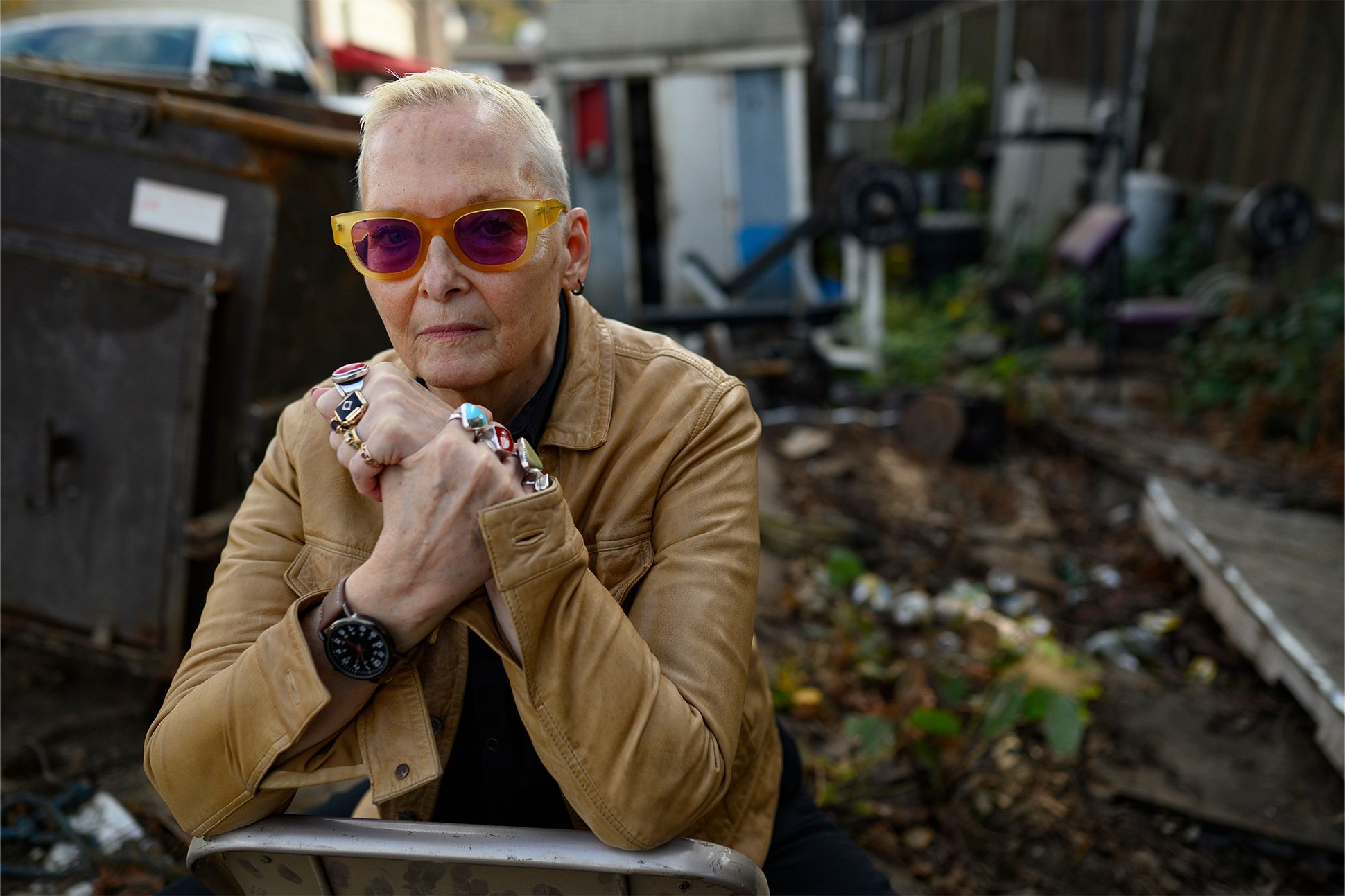
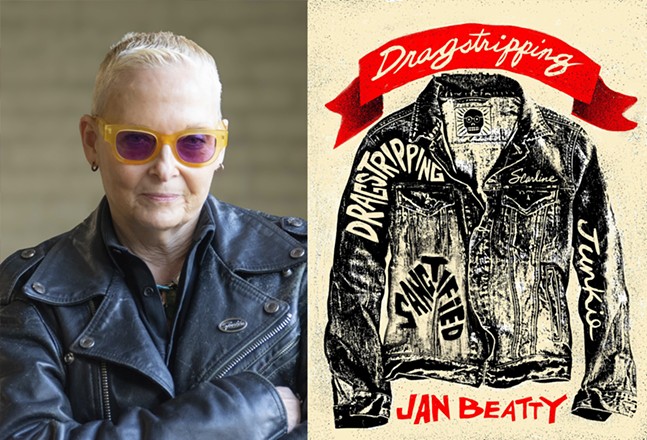
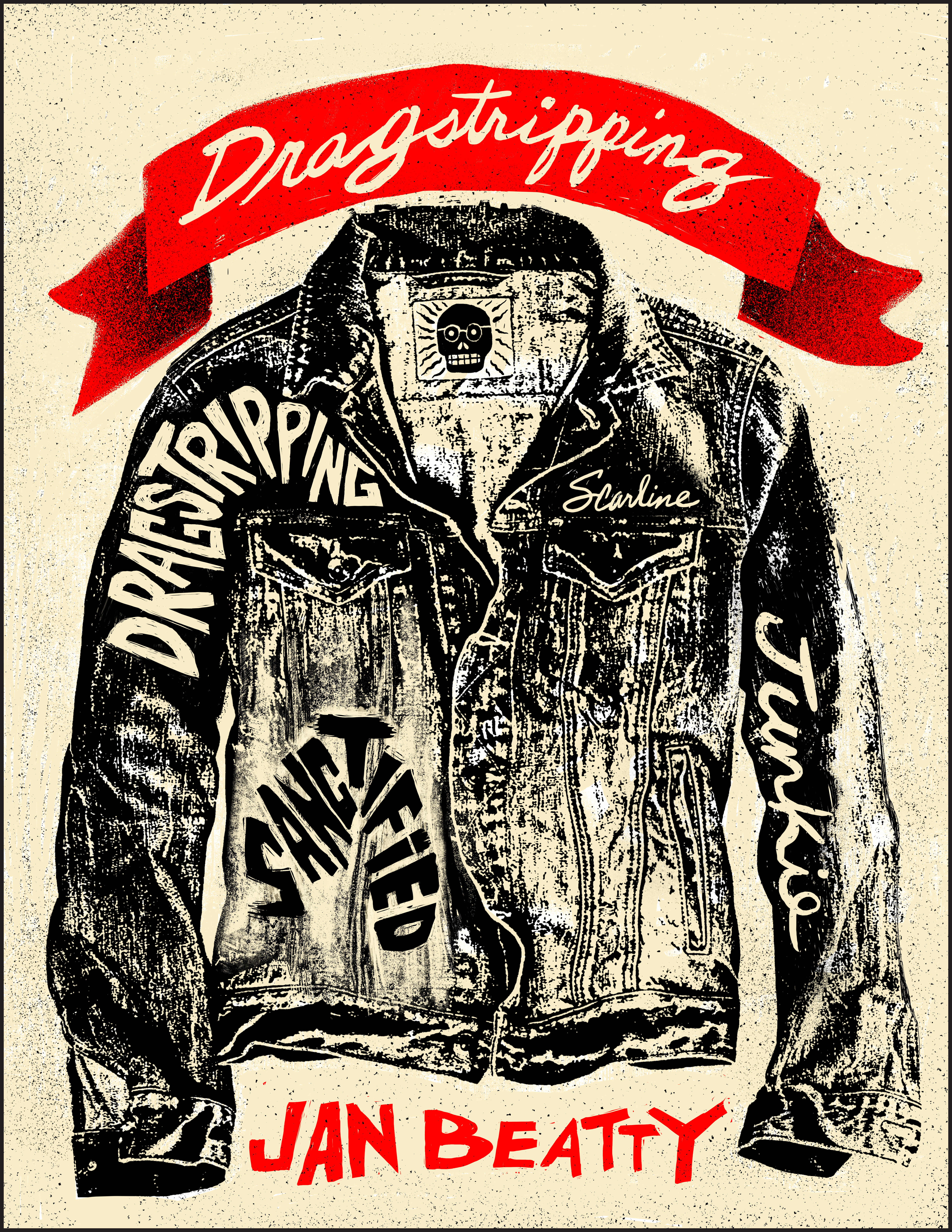
Beatty is, along with her friend Judith Vollmer, among the most influential forces in Pittsburgh's vibrant poetry scene. In her seventh full-length collection Dragstripping (2024), she writes that she is "attached to dirt: to the grit / of stones, pulverized metal from / the slag heap." It's consummate Beatty, a paean to the grimy and bygone version of her now gentrifying hometown. "I was born in a steel mill," she writes in Dragstripping, as remarkable a line of poetry in its Whitmanesque chutzpa as any I've read this year. Since her first chapbook Ravenous in 1995, Beatty has steadfastly eschewed boring poetic trends. Allergic to irony, smugness, and the onanistic experimentalism of the academic avant-garde, she has instead forged a vernacular as strong as steel: blunt, honest, and eviscerating. Having previously chaired the creative writing program at Carlow University, where she led the influential feminist writing group Madwomen in the Attic, Beatty is in many ways a latter-day punk. As Ed Ochester, her former professor at the University of Pittsburgh, once said, "Nobody has a better sense of the colloquial American idiom. Nobody among her contemporaries writes better poems about urban working-class life."
Having herself worked variously as a waitress, an instructor in a maximum-security prison, a social worker, a counselor in an abortion clinic, and a distinguished professor emeritus at Carlow, Beatty has been sounding her barbaric yawp for three decades. True to Ochester's contention, Beatty's verse exists in a nexus of exemplary technique and don't-fuck-with-me pugilism. A poem titled "Dear American Poetry" from The Switching/Yard (2013) addresses that fussy annual anthology: "Your sonnet is impotent, / and I / have a hard-on," followed by a (hilarious) string of italicized iambic pentameter, scansion marks and all, composed entirely of a derogatory word for women's genitalia and similar language describing the genitalia of a poorly endowed man. "Best American Poetry, I'm bored to death - is anyone / alive out there?" It's rare for this sort of call to come from inside the house. Any number of contemporary underground poets might share the same sentiments, but Beatty recalls an earlier countercultural pantheon.
Born in 1952 at the Rosalia Foundling Asylum and Maternity Hospital in Pittsburgh's Hill District, Beatty was adopted at approximately one year old by a woman and her steelworker husband. "My adopted mother and I never had one good moment," Beatty writes in American Bastard, although her father was a loving ally. Beatty's work explores the intricacies of the initial trauma of being given away. Much of her memoir recounts her awkward meetings with her birth mother during adulthood, and of discovering the identity of her father, a Canadian hockey player who won the Stanley Cup three times. Beatty's sense of rootlessness-she didn't know her original birth name until she was in her 30s-is why she returns to place as a fixture in her work.
"Place became a way of locating things for me, when travelling a lot, or going to the mountains, going to the West, where I feel drawn, even if I'll never leave Pittsburgh," she says.
I first met Beatty on the same day I'd scheduled an outpatient electroencephalogram, a procedure that required me to cover my scalp in electrodes hooked into a pack that I carried around my shoulder. We were at Stay Gold Books, where several local writers had been convened by the director of Pittsburgh Arts & Lectures. Because I wasn't allowed to drive, Beatty kindly allowed me to hitch a ride in her Chevy. Talking to her feels like being with a Pittsburgh prophet, a blues-shouting country-and-western punk-rocker, who writes in The Switching/Yard: "Wherever I am, I'm filled with sediment: / with tough, dirty Pittsburgh / where the mountains of black rock & / half mills are carapaces."
The working-class city she was raised in is central to Beatty's voice. "I love Pittsburgh, love the grit," she tells me at 61C Café on Murray Avenue in the city's Squirrel Hill neighborhood. "I miss the steel, miss the way the mills look, miss the fire." She laments that the recent changes in Pittsburgh-tech companies rising on former industrial sites-is its own variety of trauma. Still, she celebrates the arrival of new transplants and the city's burgeoning progressivism (while emphasizing that there remains a long way to go), as well as its growing arts and literary scene. Regardless of the role that Pittsburgh plays in her work, it's hardly the only place that animates her verse. Regions as disparate as Canada, the American Southwest, and California also appear. "I resist being called a Pittsburgh poet," she says. "That sounds like a local poet, which I'm not." Even if the city remains a touchstone, there is really only one major issue that motivates her: "I believe in women more than I believe in anything."
In an unpublished statement written for her publisher, the University of Pittsburgh Press, Beatty explains that the title Dragstripping "comes from a range of meanings of the words, 'drag' and 'stripping': the drag of walking through life without an identity, the drag of being a woman in a culture that continues to challenges one's rights, the drag and complication of gender in a drag club, the literal drag strip of racing cars." The word dragstripping encompasses both pain and pleasure, control and liberation-as do many of Beatty's poems. That she is often critiqued as bracing or raw speaks to the too-often invisible omnipresence of misogyny. An italicized poem which appears as an epigraph in Dragstripping (and which Beatty debated about placing in that position) exemplifies her concerns. She writes how she was "half-aborted by my mother's hands / and a coat hanger / But, who cares? / It's one small almost death, in the many / deaths." She effectively dedicates the collection to
The women killed and never found:
the women killed in their own homes
then disposed of; the women killed by
boyfriends, husbands, partners, strangers:
buried in the dirt of this country-
There are other ways of erasing women as well, not least of all within literary institutions. Beatty recounts incidents of rampant sexism from her graduate school days and her early career-in the 1990s, not all that long ago. At one university, a senior male professor mocked a call for submissions from queer writers of color, to which Beatty replied that his attitude (as an editor nonetheless) was precisely why so many LGBTQ poets prepare a "queer" manuscript and a "straight" manuscript. She recalls a graduate class in which the professor began by saying, "Today we'll neuter Adrienne Rich." When she pushed back, the professor finally responded, in true New Critical fashion, that when it comes to verse, "It's simply words on a page." Beatty retorted, "Well, not to me."
For Beatty, poetry is neither intellectual exercise nor fodder for the tenure file, but an incantatory statement of inner life-a protest, a jeremiad, a prophecy, a manifesto. A true working-class daughter of Pittsburgh, Beatty asks in "The Drawbridge": "Didn't you ever want to tear something down? / Smash it to make the parts talk their battered talk: // the stabbing edges & burning colors, the love compressed / in the steel beam & the raging yellow flame?"
In "California," Beatty posits that "Everyone's simple sorrow / writes a book a day - fills the hearts / of us with such pathos, bravery - & / then the small cruelties - / How do we speak to each other?" Yet her verse isn't just diagnostic but prescriptive as well, for there are moments in which she intimates the possibility of a better world within otherwise prosaic moments. In "To the Woman at the Laramie Airport," she recounts how a stranger assisted her in a dark parking lot, describing the small interaction as "Two women at night in the night / of the world. She saw me with no bearings, / she saw me afraid, she stepped up and / loved a stranger. She didn't have to / do any of it." Here is an instance of fellowship, a communion, between humans. If not paradise, it's at least a shadow of it.
As the kind of critic that I am, I can't help but read the ecstatic into Beatty's narratives, although, as she cautions, its presence in her work shouldn't be interpreted as gauzy "spiritual verse" or straightjacketed "religious verse." Even though a strong feeling of something otherworldly might appear in her work, Beatty in no way believes in a traditional God. "I don't want anything to do with religion, or the transcendent, it's a whole lot of bullshit," she tells me. The traumas enacted by organized religion, particularly the Catholic Church of her youth, are evident in her work. In American Bastard, she describes how, when she finally received a letter from her birth mother on chintzy stationary, it included a golden crucifix, the dead body of Christ hardly a substitute for all that needed to be said. And when Beatty later met her birth mother for the first time, she was gifted a plastic bottle of Holy Water from Lourdes.
Beatty's examination of organized religion interrogates the long history of violence against women that ecclesiastical and clerical culture has enacted. In American Bastard, Beatty writes that in the second grade she "went to Mass every day because of fear of death. Instead of recess-Mass. The blood. The killing, the blame for all the many sins, the black mark on your soul." Such sentiments posed certain difficulties in Beatty's position when she taught at Carlow, a historically women's college operated by the Sisters of Mercy. When she wrote a poem for the inauguration of the school's new president in 2014, for example, she refused to sit on stage with David Zubik, the infamously reactionary bishop of the Diocese of Pittsburgh. The school administration honored her position. Catholic or not, Carlow's status as a historically women's school was always most important to Beatty.
I told Beatty that the reading she gave with Richard Blanco as part of the Pittsburgh Arts & Lectures Poets Aloud series this past September felt, for me, like the kind of experience some people say they have when they go to church. Despite her skepticism toward the numinous and the transcendent, she was gracious with the comparison, and it's fair to say that Beatty's poetry does express a variety of the ecstatic, albeit on her own terms. "There is ecstasy on planet earth," she says, "in bodies joining, in dreams and desire." This is an estimably materialist paradise, no need for God at all. "Now what is holy?" Beatty asks in The Switching/Yard. "Nothing, same as before," though I'd argue that then nothing need be unholy either. Maybe more than transcendence, what Beatty's poetry envisions is utopian possibility, an imagining of future political, social, and cultural transformations. In Dragstripping's title poem, Beatty describes a self-possessed stripper who dances by "jerking to one side, head bent, / hair covers her face, breasts large and moving, / her thickness: / Wet with boysweat between her legs, / a stripshot across a pitchblack stage, / flash of a woman running her show." There is, despite itself, an ecstasy in this act-if not a grace-for as Beatty writes, "I don't believe in salvation, but / look at her body stripping."
This is a prosody of materiality, sensuality, and physicality: no spirits but bodies, and their combination and recombination. Often, this can be indistinguishable from the promises of an ecstatic faith, albeit in these circumstances one that actually delivers on its promises. In "Sanctified," dedicated to Sister Rosetta Tharpe, the midcentury blues-shouter and pioneering electric guitarist, Beatty secularizes the singer's gospel-inflected performance while divinizing the rest of us. She writes,
I love your high-
heeled guitar playing, the way they said you railed
your white Les Paul Custom like a tommy gun:
gospel-wild and showing the men how it's done-
The language is evocatively sexual, and there is an encomium to Tharpe's own self-possessed playing, her "dress breathing red flowers / hugging your full-size body." The speaker doesn't "want to be redeemed," but in the gospel performance itself, "hearing your soul-heavy voice surge ... I'm saying what you always knew - / that real is real" Despite there being no happy endings, Tharpe and her fellow blues shouters remain "scorching, / sanctified." Even if there is no heaven, there is still a way to sanctify ourselves in a world where only the real is real.
These utopian intimations, abundantly physical, are what make hope both possible and necessary in Beatty's poems. Hers is not a poetics of the spirit but of the body. In "Blood Ring," she writes that she "cut a tunnel through my father's onyx ring, / cut the diamond out & stone-fired a garnet / in the center," but she "asked the jeweler not to clean / the band & bridge so my father's DNA / could bleed into my skin." If there is anything sacramental in Beatty's poetry, it's this: we all have bodies, capable of both pleasure and pain, comfort and cruelty. And if there is communion, it's to be found in those connections, where the wearing of her beloved father's ring, years after he has passed, serves as a form of reverence and embrace. There is a similar singing of the body electric in The Switching/Yard, in which Beatty describes the "body of sturdy days; body of spasms, scrawny, familiar / body of fair play, limitations and reminders; aching / that interferes ... body of arousal and the collapsing bridge: / shadow of the architecture that was my life."
A veritable liturgy, this passage is an abstract blazon of the body in its excesses and constraints, a wild and intoxicating reminder of the physical rendered in language that acknowledges our finitude. In a place where people live on developments constructed atop slag heaps, it's impossible not to understand the crushing grandeur of the physical. In "The Drawbridge," Beatty notes that the "bodies of the steelworkers / weld into one - // & the city of questions sleeps - / & the steel flakes in the lungs speak / & the outside law falls null & void -." The intermingling of the bodily and something else, something wilder and bigger than any of us, is even used to describe Beatty's own conception in American Bastard. Despite irreverently writing that "I was the immaculate cum-shot," she also imagines the moment of her conception in "Ghostdaddys": "I hope the sex was ravenous ... I hope there were slats of light everywhere / to see my star on the other side."
Beatty is a poet for whom authenticity, that ever-difficult term, is neither a pose nor a social media marketing gambit. She writes honest poems in a manner that seems scarcely practiced anymore, or at least scarcely published in widely read venues. Separate from the academy, Beatty argues that "poetry needs more openness to community voices and all ages, especially women's voices. It's still too controlled by men, even if people don't think so." This piece is the first extended critical essay on Beatty to appear on the Poetry Foundation's website, despite her three decades' worth of influential and award-winning work. (Poetry magazine has published her poems.) That her work can still be read as radical, even shocking, speaks not to their content but to her being indispensable. Beatty identifies that which bedevils a culture-in some ways, a prophetic vocation. She also gestures toward a more expansive world, which is maybe even more important.
In this liberating task of expanding human connection there are poetic touchstones, certain names that appear and reappear in Beatty's work, often musicians: Sister Rosetta Tharpe, Howlin' Wolf, Jimi Hendrix, Jim Morrison. Then there are her contemporaries and the poets of the generation before her: Ochester, Vollmer, Wanda Coleman, Diane Glancy, and Etheridge Knight, from whom she learned the practice of including slash-lines in her work. Finally, there are the younger generations of poets working in her stead from whom Beatty draws both succor and inspiration, often friends such as Bruce Snider, D.A. Powell, C. Dale Young, and Iris Jamahl Dunkle. If there is a single gospel in Beatty's work, it's a gospel of poetry's ability to organize and explain, restore and bolster, perhaps even (my word) sanctify. Beatty uses poetry to speak on not just her own behalf, but also for those disappeared women to whom she dedicates her writing, for women's voices in the classroom and the street, in the barroom and the shelter. Such verse isn't just a description of life, but, when written in a certain way, can actually be life. As Beatty asks of us all, "who wants a watered- / down heart?"
American Bastard or American Badass? Jan Beatty exemplifies both in new memoir
by Rege Behe
The cover photo shows a young girl smiling as she points a toy gun at the camera. At first glance, the book's title seems to be American Badass. But the correct name of Jan Beatty's memoir is American Bastard.
Both titles ring true. Beatty, a poet and writer from Regent Square who was adopted just after birth, calls herself a bastard throughout the book. And the sobriquet "badass" exemplifies Beatty's determination and doggedness in searching for her birth parents.
"I knew what the cover was going to be if I ever did this book," Beatty says of her memoir, "and I knew it was going to be red and black, and I knew what the name was going to be. I just had a vision of it, and I had this photograph from many years ago of me with a toy shotgun. I was six years old and already in high tops and shooting people, so my personality was already there."
American Bastard (Red Hen Press) is the oft-harrowing story of Beatty's search for family and identity while navigating life as an adoptee. Beatty recounts how she felt lost through much of her childhood, constantly afraid of being sent back to Roselia Asylum and Maternity Hospital in Pittsburgh's Hill District.
The story took years to germinate and unfold, if not understand. About 20 years ago, Beatty wrote a story for Creative Nonfiction about being adopted, but "I couldn't keep going," she says. "I was already in therapy, but I needed to work on it more in therapy because there was a lot of emotional stuff in the book. And I needed to mature also as a writer because I didn't know how to handle the material, especially in prose."
For Beatty, being adopted came to mean never being accepted or believed. When a peeping tom climbed a ladder to her second-floor bedroom, the incident was initially dismissed as being a creation of her imagination.
"As an adoptee, you're erased," she says. "Your history, your name, everything is erased. So it's really hard to be seen at all, and, then, if you have stories people don't think are real, that's a problem."
To isolate herself, Beatty climbed a ladder to the attic of the family home and closed the hatch behind her. There, amid boxes and rolls of pink insulation, she lost herself in books, preferring the Hardy Boys over Nancy Drew because Carolyn Keene's character was "too nice and they were putting her in dresses," she says.
"I'm sitting on 2x4s and bracing myself up there," Beatty adds about her attic refuge, "but I just needed to get the hell away from everybody and read and make little notes. I think that was me writing and saving myself because I had to live somewhere else because I couldn't really live where I was."
She says it wasn't that it was horrible, but that it "didn't have anything to do with me."
After meeting her birth mother, Beatty sought her birth father. Going on scant clues - Beatty only knew that he had played hockey for the minor league Pittsburgh Hornets and was the team's best player - she eventually discovered Bill Ezinicki was a golf pro in Massachusetts who had been a member of three Stanley Cup winning teams during his professional career. He was also known as a ferocious competitor, willing to doff his gloves and fight.
"You never know what you're going to find," Beatty says, "and I did ambush him, so he didn't have time to prepare. I got a view of him as a human, and I really liked him."
But two weeks later, Ezinicki called to say he wanted nothing more to do with his daughter.
About 10 years ago, Beatty traveled to her father's birthplace in Winnipeg, Manitoba in Canada to get a sense of his life and her heritage. As a child, Beatty had been especially competitive at racquetball and softball, and she grew to believe that was due to her father's athleticism.
But the connection she made in Winnipeg, where she got a private tour of a Manitoba Hockey Hall of Fame and Museum to view some of her father's memorabilia, was even deeper.
"Before I knew about my birth father or that I was half Canadian, I had already been riding trains back and forth across Canada, maybe four times," Beatty says. "That's inexplicable. Who does that? I was just driven to run around Canada before I knew, and that's why, when I found out, everything made sense and all my history of being an athlete made sense, and fighting everyone made sense."
While Beatty wanted to tell her story, the gist of American Bastard is about what she calls "the big lie, and the big whitewash" of adoption. Families who adopt children are often viewed as saviors, rescuing kids from lives of neglect.
But Beatty believes adoption "is not fair to anyone," she says. "It's not fair to the kid because everything is erased, their history is erased. It's not fair to the adoptive parents, either, because if they're set up to be saints, which they are, but nobody is, they have to be saints. But they need to be human, and that's the same with all mothers," she adds.
"There's this thing that is placed on all women, that they're either saints or sinners. Let's just let people be people with their flaws and their good parts," Beatty says. "Let's not make everybody a savior because it's not real. And especially for an adoptee, you need something that is real because everything real has been taken away from them, and all they have is this lie about how they got there."
Pittsburgh poet's memoir explores the trauma of being an adopted child
by Bill O'Driscoll
Who, a reader might ask, is Patrice Staiger, whose haunting epigram "This story begins at an impasse, since I am writing to you as someone who was never born?" prefaces Jan Beatty's new memoir, "American Bastard"?
"Staiger" is none other than a stand-in for Beatty herself, employing her birth name to set the tone for this blend of narrative and poetry that doubles as a searing critique of adoption culture in America.
While "American Bastard" (Red Hen Press) is Beatty's first work of nonfiction, its themes and even a few of its stories will be familiar to readers of this veteran, Pittsburgh-based poet and educator's six collections of verse.
Beatty was born in 1952, at the Roselia Foundling and Maternity Asylum in the Hill District, known in the parlance of the day as a home for unwed mothers. She grew up with an adoptive family, mostly in Baldwin. She didn't learn her birth name until she was 32, though she later tracked down both her birth mother and the man she considers her birth father.
By way of telling this story, "American Bastard" takes a sledgehammer to what Beatty regards as the reigning myths about adoption - chiefly, that adoptive children are "chosen babies" who should be grateful for their adoptive family. The truth, Beatty contends, is that adoptive children are traumatized by "the loss of medical history, the loss of our names, the broken bond with the birth mother, and how that is a primary lifelong loss that no one discusses." An adoption can be many things, but at heart "it's a business transaction, it's a sale of an infant, and no one really discusses it in the way it actually happens," Beatty said in an interview. "I think that's really a problem to pretend it's otherwise."
Beatty is also widely admired for her teaching. She directs the creative writing program at Carlow University and also heads the Madwomen in the Attic poetry workshops there.
Some of her trauma as an adoptee was due to the laws and mores of the era in which she was born, when births out of wedlock were heavily stigmatized and adoptions were "closed," meaning children were legally barred from learning about their birth parents.
Beatty knew she was adopted from early childhood, but more importantly, she felt it: She looked nothing like her parents or her older sister (who was also adopted), let alone her cousins. Having been given away once already, she writes, she lived in constant terror of being abandoned again and faced the unrelenting challenge to prove herself worthy. The adoptive child, she writes, "is trying to build a right way out of nothing, out of watching others, trying to figure out what it is they're doing to make themselves acceptable children."
Beatty's birth mother, a working-class woman from Garfield who lived with her sister and widowed mother, gave her up largely because of her dire economic straits. Beatty's adoptive parents were more stable financially - her father was a mill worker - but her home life was fraught. Beatty says she and her adoptive mother "had really not one good moment - like not one." As a child, Beatty often hid in the attic and read; her father, whom Beatty recalls "a great guy," built her a wooden platform in her hideaway and was much more sympathetic.
But Beatty emphasizes that her critique of adoption culture isn't a matter of her personal relationships. "I've read all the books I can find on this subject, and I usually throw the books across the room because there's this whitewashing going on. It's like, this need to make it pretty, to make it good, this good thing that people are doing, saving these babies, and no acknowledgment that, 'Look, you might be doing this for yourself.'" (Exceptions include the writings of the late adoption-reform advocate Betty Jean Lifton, whom Beatty quotes several times in the book.)
While "American Bastard" is not a book on public policy, Beatty said in an interview that, at a minimum, she'd require adoptive parents to undergo therapy to understand their true motives - and she'd like adoptive parents to tell adoptees, "I'm sorry for your loss" rather than insisting, "Everything's going to be OK."
For Beatty, the desire to know one's birth parents is as inborn as the traits one inherits from them. As an adult - and before she moved from social-work jobs and waitressing into poetry and academia - Beatty found her birth mother. They would meet only three times, and the relationship was awkward, to say the least. But Beatty saw echoes of their blood kinship in their fashion choices at the time: On first meeting, they both wore the same style of dress, and her mother wore a pair of shoes she could have borrowed from Beatty's own closet.
While her mother was deeply reluctant to discuss the circumstances of Beatty's conception, Beatty learned enough to track down, in 1988, the man she considers her birth father: the late "Wild Bill" Ezinicki, a professional ice-hockey player who won three Stanley Cups with the Toronto Maple Leafs in the late 1940s. Ezinicki, a winger, also played several seasons with the Pittsburgh Hornets of the American Hockey League, which would have been how Beatty's mother met him, in 1951. (The Hornets played at the now-vanished Duquesne Gardens, in North Oakland.)
On Beatty's first meeting with him, she writes, Ezinicki said it was possible he was her father, though he later phoned her to say that he wasn't. But Beatty is sure of it, and traces to the hard-playing, Winnipeg-born Ezinicki - a noted cross-checker who once led the NHL in penalty minutes - everything from her youthful love of hitting things (softballs, tennis balls) to her compulsion as a young adult to travel to the Canadian West. "Before I knew my birth father was Canadian," she says.
"The body and the blood is everything to an adopted child, and I think to everyone" she adds. "I mean, they may not think about it as much because it's part of their natural existence. But if you don't have that connection, if you don't have that link to your blood, it becomes really important."
Beatty says she has been trying to write this memoir for decades - perhaps even, in a way, for her whole life. But she needed time.
"I feel like I needed to do more work in therapy to get to get to these places," she says. "And also, I needed to grow as a writer to learn how I could possibly write this book."
But it was a book she had to write, she says, because "I couldn't find it anywhere. I couldn't find anyone saying anything like this because they were all making it nice, and that was driving me insane. And I wanted it written down that, 'Hey, look, this is this is how it was for me, and this is how it is, I know, for a lot of other adoptees."
She quotes her dedication to the book: "This is for the lost ones who never knew where they came from. This is against the ones who pretended the loss never happened."
Grab Hold The Rope of Language: A Conversation With Jan Beatty
by Julie Marie Wade
Twice a week for a year, I walked from my day job at Carnegie Mellon down Fifth Avenue to Carlow University. An adjunct professor in the Women's Studies department, I freshened up before class in a basement restroom. And then, on my way up the stairs, I passed Jan Beatty's office. I knew Jan from poems of hers I had read in graduate school and also from her unforgettable voice on the radio; she hosted a poetry podcast called Prosody that I loved.
Every time I passed Jan's office I wanted to say something. I could see her in there, bent over her desk, working, probably writing some more spell-binding poems, but I didn't know what to say. Jan was so cool. (Jan is so cool.) I loved her style, her big mind, and her unflinching honesty. I loved how she carried herself in the world and how she carried herself on the page.
So, I never introduced myself to Jan Beatty, and when I left Pittsburgh in 2007, I doubted our paths would ever cross. How lucky I was to be wrong about that-and how lucky I am that she agreed to have this conversation with me for The Rumpus.
The Rumpus: You've been described by reviewers and blurbers-and I have described you in teaching your work!-as a "feminist poet." So I'd like to start by asking some big questions: what does feminism mean to you, and what does poetry mean to you?
Jan Beatty: These are massive questions, lifelong questions, shifting and complex questions. I'll answer in the present tense, in the best way I can, knowing that tomorrow I might answer them differently.
Feminism is all about choice to me: the choice over my own body and life. How I want to walk around the world, how I want to present myself. It's all about freedom-reproductive freedom, freedom to speak, write, work, love whoever and however I choose. It means not taking shit from anybody, and especially not from men-who have taken up too much space in the world for far too long.
Poetry is and always has been about staying alive. How can I walk around a world that often makes no sense, feels alien (not in a good way), and feels restrictive and unimaginative? The answer for me has always been to dive into poetry, to grab hold of the rope of language and see what resistance is there.
What is on the other end of wandering, getting lost, leaving the present tense and floating into dreaming? That place of calm and different vibration brings exhilaration, discovery, confusion, brick walls, new sky.
To find the words, the stories that feel "real," the voices that feel "authentic"-that's everything. These words have the power to move people and change their minds and my mind. The possibilities of that engagement are spirited, and those times when I seem to wake from hours of that exploration make staying alive make sense. Of course, this is love and connection, and there's no substitute for that.
Rumpus: How do the words "feminism" and "poetry," in all their multivalence, coalesce in your experience?
Beatty: It's not the words "feminism" and "poetry" that coalesce but the meanings. There's no way that I would have survived as a poet without feminism, without the right to choose. I never thought I had the right to be a writer.
I was born in a place called Roselia Asylum and Maternity Hospital in the Hill District of Pittsburgh, and I didn't know my real name until I was thirty-two years old. This is the story of my memoir, American Bastard, coming out in October with Red Hen Press. My adopted father was a steelworker, and I was brought up solid working-class. I was the first in my adopted family to go to college, and I never thought it was possible to become a writer, even though I had been writing all through my childhood. I attended West Virginia University because my boyfriend was going there. As a freshman, I stumbled into a women's consciousness-raising session on campus-it was the 1970s. I remember saying to this group of rabid feminists that I didn't think that women were oppressed at all. All the heads in the room turned. By the end of that first session, my life had changed as the beautiful women in that room began to school me.
I took no writing classes in college, and I majored in physical education, journalism, nursing, and then I got a degree in social work. After working as a social worker in maximum security prisons, abortion clinics, and the welfare office, I gave up on any idea of cultural "success." I became a waitress and started to write again. I started taking night classes in poetry, one at a time, at the University of Pittsburgh. With the models of brave women writers like Sylvia Plath, Anne Sexton, Adrienne Rich, Sharon Olds-who risked so much at a time when women were not being published-I found a lifeline.
Rumpus: As a professor, mentor, radio host of Prosody, teacher, and series editor of Madwomen in the Attic, how do you reach people who may be resistant to or intimidated by poetry? How do you reach poets who feel "stuck" in their writing process, confronted by more brick walls than new skies?
Beatty: I think that's everyone at one time or another. Who hasn't felt less than, not up to the task, a fraud in the world of art and poetry, wanting to hide under the closest table? Remembering the vulnerability of writing a poem, opening the self up to emotion-while finding a way to push people forward is a skill developed over a lifetime. If we're lucky, we've run into those amazing teachers.
I believe in the power of poem to open up resistance and fear. We know that the words on a page are not just words on a page. I had that fight with one of my professors in graduate school at the University of Pittsburgh. It was Teaching Seminar, and Joe Harris said in class: "Let's, for a minute, neuter Adrienne Rich." He actually said that. I raised my hand: "What did you say?" When he repeated it, I said something like, "No, no, no, no. What are you talking about?" He wanted to talk only about theory, while trying to erase one of the bravest writers who has ever lived. To his credit, we kept fighting, and then we fought face-to-face, five inches apart, for a half-hour after class, until he finally said, "Well, to me, poems are just words on a page." "Oh," I said, "not to me."
I knew that poems could change a life. I knew that I needed to be around women, and I walked down the street that day to Carlow University to join the Madwomen in the Attic, taught by the amazing poet, Patricia Dobler. I was in graduate school at Pitt, but what saved me was the community workshop of the Madwomen, ages eighteen to ninety-five. I needed to be heard, and this became my new home.
Rumpus: What poem has been the most important hammer/wrecking ball in your life so far? Why? And what poem have you written that feels like the most important hammer/wrecking ball you have given to your readers so far? Why?
Beatty: There have been so many wrecking-ball poems in my life, thanks to the killer poets out there who tear the lid off of life and let us all breathe. One of the essentials has always been, "The Language of the Brag," by Sharon Olds. I love the voice: I have wanted excellence in the knife-throw... I have wanted some epic use for my excellent body... I love the extreme courage, the direct arrow of language, but especially the ending where Olds calls out the "masters":
I have done what you wanted to do, Walt Whitman,
Allen Ginsberg, I have done this thing,
I and the other women this exceptional
act with the exceptional heroic body,
this giving birth, this glistening verb,
and I am putting my proud American boast
right here with the others.
- Sharon Olds, Satan Says, University of Pittsburgh Press, 1980
I can't read this, still, without waves of fuck, yeah! running through my body. Thank you, Sharon Olds, you incredibly brave, inspirational poet! How did you do that those many years ago-when the political climate was worse for women, and especially women writers? Heroic. When I'm afraid to write something, sometimes I'll think of Olds and all the women who've come before, who have risked and written through tougher obstacles.
I don't know what poem might be a hammer/wrecking ball for my readers, but I would guess that "Shooter" from Red Sugar might be one. That poem was a wrecking ball for me when I wrote it. I was in Sheridan, Wyoming, at Jentel-the writing residency-and it was late at night. Late one night, who knows why-I thought I should make notes of all the times that I had been abused, assaulted in my life. This went on for hours, until I started feeling sick and weird. What was I doing, out in the middle of nowhere? I didn't know that I was writing a poem. It started to go to a darker place, as can happen with abuse, and I started to think I was mentally ill, that something was terribly wrong with me. Why was I writing this, and why did all this happen? I put the pages away until I was home and grounded in Pittsburgh, and I took parts of it to my friend and killer poet, Judith Vollmer. "Is this a poem?" I said. "Definitely," she said, "but you have to cut it back, find the movement." I worked on many drafts of "Shooter," making it a much shorter poem about the violations that happen to women on a daily basis.
I've had a lot of resistance to the poem and also a lot of response from women who relate to it. At an auditorium reading at Monmouth University, an older man told me that I shouldn't read "Shooter" because it would upset the young women in the audience. I told him that I thought they knew about these things. An editor of a major press told me that it was man-hating; a woman colleague told her students that it was hate speech. I had intense exchanges with both of them, and many other people who reacted to the poem.
One night, at an outdoor festival in rural Pennsylvania, I was reading with a group of writers. They were wonderful writers, but seemed to be playing it safe with their poem choices, with not one word of profanity all evening. I was the final reader, and I was wondering if the audience might be conservative in their tastes. I had planned on reading "Shooter" and some other tougher poems. I decided against it. But when I stepped up on stage and looked at all the women out there, I said, "Fuck it." I read "Shooter" and the other poems that I had planned on, and when I went to the food tent, there was a line of about fifteen women waiting to talk with me. It was stunning, as woman after woman started telling me their stories. We were in line for over an hour.
One woman, who I will never forget, told me that she was raped and that her husband told her it wasn't her fault. She was crying, "I'm sorry," she said, "You're the only other person I've told." Her husband was standing ten feet away, holding on to the tent ropes, looking at his shoes. It was devastating. I hugged her: "It's not your fault; it's not your fault," I said, and we talked and sat and cried. After that, I decided that I would always read "Shooter" even if it felt strange, that I would send it out into the universe. There's no way to know who is listening or how someone hears the poems. And, I needed to remember how "The Language of the Brag" and so many other wrecking-ball poems helped to save my life.
Rumpus: Let's talk about how this aesthetic-which of course is more than an aesthetic but also a worldview, a commitment to truth-informs your new memoir, American Bastard (Red Hen Press, 2021).
Even the title is arresting. The reader, or at least many readers, will encounter the word "bastard" like a live ember. It registers as a word we aren't "supposed to" say, perhaps a word that isn't "polite" to say.
Then we open the book, and it looks different from how we may expect a memoir to look. The chapters are short with provocative titles. One of my favorites: "My mother was a dress." We might wonder about genre. We might wonder about the dialectic between your work as a poet-"red sugar" appears multiple times here-and your work as a writer of prose.
How are they connected? How do they diverge? Why was it important to you to write this book as you wrote it? (I want you to know, as I have been reading, fuck, yeah! is running through my body.)
Beatty: As a young woman, I was so shy, I couldn't talk with people. Some of this is in my memoir. I was lost and looking to disappear. I remember being with my parents as a young girl in a department store. They were buying school shoes for me, and I remember saying to the clerk that I wanted a pair of quiet shoes, a pair that no one could hear when I walked. So, it's been a lot of years and a lot of living to be able to say these things directly.
American Bastard is a whole other thing, with its own life. I've wanted to write this book for as long as I can remember-before my poetry books, before I was teaching. I've been obsessed with writing about being adopted, because I never saw this story anywhere. It was the story I needed to read as a child, a teenager, an adult-and it never appeared. There were books about adoption, yes-and the work of Betty Jean Lifton saved me with their honesty and research. But, the story written by an adoptee telling the truth of how it was-that was never written without whitewashing, without compulsory gratitude, etc. Years ago, I had a vision of this book, with the cover. I knew the title, and I knew I wanted to use that photo of me at six years old with high tops and a shotgun-it was the language I knew as a child. I was always a boy growing up, and this was my protection stance, my fuck-you to the world, as in, "Stay away." The story of the chasm between the shotgun boy and the quiet-shoed girl is the memoir.
In my vision, I knew it would be a red and black cover. It wasn't a plan but a vision. I never thought I could write this book. When I finally felt strong enough to write it, I found a book proposal from 2000 that I had put together but never sent out.
I found it immensely challenging and sometimes terrifying to write this book. Digging into the past of adoption brought up so many internal conflicts, periods of confusion, nothingness, ambivalence, fear, self-loathing, all of it.
You ask me about the form of American Bastard, the short sections, the crossover poems, provocative titles.
I had notes and notes and journals and journals over years with adoption work throughout. When I felt that I could actually start the writing of it, I was stuck. I had written some boring paragraphs, some overly "polite" introductions. I had gotten some advice to "welcome the reader in," to not "antagonize" the reader with intensity. I tried that. I was boring myself. I took parts of a manuscript to writers I respect, and they felt it was too confrontational and that it needed to be more chronological. One writer I love suggested that I tell the story with the adoptee on a train as she goes through all these chronological journeys. "I can't do that," I said. "Why not?" he said. "Because that would make me want to die."
I had brought a topographical dictionary with me across the country-Home Ground, A Guide to the American Landscape, by Michael Collier; eds. Barry Lopez and Debra Gwartney. I had a special connection with Barry Lopez after meeting him at a writing retreat in Sitka, Alaska, and his presence through this book gave me even more grounding.
When I finally wrote the first of many drafts of American Bastard, I began each section with a quote from Home Ground. I was devouring the dictionary-something I used to do when I was younger. (I kept a huge red-leather bound dictionary in my bedroom closet during my entire childhood.) I was going by instinct, looking for what felt like metaphors for my story: terms like infant stream or storm beach. These became epigraphs for many sections, and they guided me through stories like a split/screen adventure, a twisted road trip. This is how I was able to get the beginnings of the book on paper, and then, of course, there were many drafts and revisions.
There are some poems in the book that have appeared in earlier books, such as "My Mother Was a Dress." These poems often appear in different forms. Although the use of instinct and leaping both appear in my memoir and in my poetry, the writing of my memoir was drastically different. The challenge of writing nonfiction remains daunting to me, and I take refuge in the comfort of the "speaker" in poetry. I'm driven towards an authentic voice and a "sense of truth" in my poems, but definitely not a sense of literal truth. The responsibility of the nonfiction writer to truth feels heavy and almost unattainable to me.
When I sent my memoir out for publication, I was lucky enough to get referrals from wonderful writers who connected me to their agents and editors. I could use their name, they generously said. In every case, the same response-the editors said the story was "harrowing," "stunning," "heartbreaking" -but, could I make the story chronological? I was frustrated, since I couldn't remember most of my childhood, and, more importantly, I felt a drive to write this story with a leaping energy.
After four years of sending out the book, I was ready to give up. Two things happened. An Irish writer friend asked me if the editors I'd been dealing with were men. "Yes," I said. I couldn't believe that I was sending my strange, leaping book to only male editors. I'm usually much more awake than that-"Oh my god," I said, "What am I doing?" "Try some women," she said.
The second thing may seem odd, but I went to my astrologer about some life issues (not the book), and she said, "What's up with the memoir?" "It's dead," I said, "I'm done with it." "No you're not," she said, "Look at this." And she pointed to all this publication in my chart. "It's right here. It's coming out," she said. "Send that thing out." I'm telling you the truth when I say that I wouldn't have sent out the manuscript again without those words from my astrologer. A year later, I won the 2019 Ren Hen Nonfiction Award. Chosen by a woman, Nikki Moustaki. Managing editor, Kate Gale.
On American Bastard, a memoir by Jan Beatty
reviewed by Michele Sharpe
Any baby, let alone a bastard baby, is born a mystery, and babies don't come with directions. But Jan Beatty's iconoclastic memoir American Bastard does come with directions. Here is how she tells us to read her story:
"Try staying with the foreign idea that a baby is born, then sold to another person. Stay with it. There is the physical trauma of the broken bond. There is the erasure of the baby's entire history. There are these hands that have a different smell, a different DNA - reaching for the baby, calling it theirs. Stay with that for a while. No talking."
These directions gave me, as an adoptee, the sense of relief I often feel with precise parameters for listening to an adoptee's story. So much of American adoption history is hidden, sugar-coated, and ambiguous. Beatty's directions ask us to engage in the most essential element of critical thinking: putting aside underlying cultural assumptions in favor of listening to an outsider's story.
America's adoption narrative has been honed for decades by the adoption industry into simplistic images: selfless birthmothers who give up their infants to better lives, lucky adoptees who are so much better off than they would have been had they stayed with their birth families, and adoptive parents who are the saviors of these poor children. The word "poor" here can function as an economic descriptor, since most birthmothers are working class and most adoptive parents are, at least, middle class. They must be: one agency, American Adoptions, estimates the cost of a domestic adoption is between $50,000 to $60,000. The same agency estimates international adoption costs are between $35,000 and $50,000.
Beatty is a white, domestic adoptee who was born in the 1950's during the "Baby Scoop Era," a period between 1945 and 1973 when entrepreneurial adoption agencies capitalized on societal shaming of single mothers and created record-breaking numbers of domestic adoptions. In the 1960's alone, at least 2 million women relinquished infants for adoption.
Defining herself as a bastard, Beatty transcends the social context of her adoption through an archetypal journey motif that strikes universal notes. A poet by profession and by nature who has garnered numerous awards, she enriches the memoir genre with lyric elements and poetic strategies including sonic resonances, slashes, and line breaks. She also includes documentary evidence, including her original birth records, the sort of records that are routinely denied to most American adoptees.
The story begins with a child who longs to find resemblance but doesn't, then shifts to the adult woman who finds "ghosts all over the story of my beginnings." Told at a young age that she is adopted, she lives as a "split" child, one with fictional parents she must accept as real, and birthparents she must accept as disposable. Tracking the tension inherent in this split, the book dispenses with chronology by casting forward into the future as it reaches back into the past, enacting the diverse and recursive nature of experience. This process was complicated, as Beatty writes in a brief email interview:
"The writing of American Bastard was really different from writing my poetry books. I've been working on this book my whole life-as in, dreaming of it, trying to find a form in which to write it, looking for the courage to write it, etc. Although my poetry can be intense and deep, this memoir gave me no escape. There was no 'speaker' to refer to, as the 'I' in the poem. This was all me, all true, and that was terrifying."
This back and forth between past, present, and future steers the reader away from questions seeking linear answers, such as "Why didn't her mother just tell her who her father was?" and toward the more timeless questions of why we crave connection with our ancestors and how blood shapes identity, whether we like it or not. Without a linear narrative, it's easy to question the "happy ending" pictured in adoption agency marketing materials. Many adoptees, including me, say that there is no "ending" to their adoption story; its effects are ongoing.
But if all adoptions don't end happily, how do they end? Data on adoption is sketchy, since the practice has been shrouded in secrecy for decades. In most states, adoption records are still sealed, and new birth certificates are issued upon adoption, erasing the original birth certificate. This means that rather than studies based on surveys and demographics, much of the evidence about adoption outcomes is anecdotal and therefore exceptional. It's the stories that deviate from the norm that are told, and that we remember.
In 2018, for example, there were at least two mass murders of adoptees by their adopters. In California, Jennifer and Sarah Hart drove their six adopted children off a cliff to their deaths, and in Tennessee, Cynthia Collier shot her four adopted children to death before turning the gun on herself. These stories, especially the one about the Hart family where the adopters were a lesbian couple, received a great deal of attention. At the other end of the outcomes spectrum are the celebrity adoption stories portrayed by mainstream media as fairy tales. Less publicized are the few adoption outcome studies based on data, including one that shows adoptees are four times more likely to attempt suicide than non-adoptees.
Stories from the adoptee perspective like American Bastard are especially critical in this absence of data, particularly since that absence leaves room for our culture's habit of erasing the stories of poor people and equating white, economic privilege with virtue and with the norm.
As an adult, Beatty wrestles with the adoption industry to obtain her birth records. After many miscues and refusals, she meets with her birthmother, beginning a second struggle to learn her father's identity. The process is far more difficult than the happy reunions of separated families that we see in popular media. Beatty's birthmother is reticent, reluctant to give up information, and conflicted about incorporating Beatty into her family. Still, Beatty writes, "To see her, to have a face, a body that is actual and real. That part is probably the most important. As an adoptee, I need that face, that blood connection to not feel as alone in the world. That is everything. Everything." What follows isn't easy, though. The real-life difficulty of managing the blood connection with years of unanswered questions and denial forces a knotty density into their relationship.
Beatty employs an astonishing number of rhetorical and poetic devices in this book, creating a stylistic density, like a garden with many different species of plants. Some devices enact a paradox, as in this excerpt from a section titled "The term mainland suggests some immense solidity":
"My birthmother lives in the center of me and she lives outside of me. She covers all ground and yet I don't know her. She is farther than the horizon - no end to her. She gets her power from blood - nothing else."
Each sentence contains two clauses, and each clause works in opposition to another. In addition to its sense of rhythm, this pattern mirrors the paradox of Beatty's simultaneous existence as her mother's daughter and as not her mother's daughter.
Some sections of the book are lineated as poetry, and some, lineated as prose, are less than a page long. I appreciated the amount of white space created from these choices, signaling space to think about the preceding text, but this is yet another paradox. Containing more white space than the traditional memoir, the diversity of techniques creates a sense of clutter, not unlike the clutter of genetic difference that surrounds an adopted child like Beatty, who grows up craving the order and simplicity of physical similarities shared by her adoptive cousins. "I longed for that sameness with someone - a body part that I could share, something that would bond us without speech."
Most people in the United States who are adopted must clear many hurdles to learn the truth about their parentage. Some, including transnational adoptees, may never learn their truth thanks to agencies' failures to preserve records. Forty of our 52 states still limit adoptees' access to our original birth certificates, thanks to laws enacted in the 20th century when adoption evolved into a for-profit industry. Beatty, born and adopted in the 1950's, began searching for her truth long before DNA testing was widely available, but today, many adoptees pay for DNA testing, which can help them dispense with the flawed or deliberately false memories of others.
In search of her identity, Beatty expresses concerns that are both universal and personal. What was the moment of her conception like? Who are her ancestors? Where, and with who, did she spend her earliest days? The answer she finds to this last question reflects one widespread, callous adoption practice of the 20th century: Beatty was kept in an orphanage for about a year until a white family adopted her.
Research shows that the separation of infants from their biological mothers, even for a short time, can cause changes in brain chemistry and a failure to thrive. In response to that research, babies born in hospitals are no longer routinely separated from their mothers as they were in the 20th century, when doctors and other professionals viewed infants as blank slates who had no attachments, preferences, or emotional vulnerabilities. As documented in another adoptee memoir published in 2021, Megan Culhane Galbraith's Guild of the Infant Savior, a "mothercraft" degree program at Cornell University in the 1960's used infants from orphanages as "practice babies" for students of homemaking. These students rotated in and out of a practice home while babies spent their days being passed from one set of hands to another to another.
It's fitting that American Bastard proceeds by leaping, connecting, and separating since that is the form that Beatty's life has taken. Her goal was to "create an authentic voice, and to make the story as real and true as possible." From one adoptee to another, it's my pleasure to say that she succeeds.
Review: Jan Beatty unleashes an adoptee's anger in 'American Bastard'
reviewed by Kristofer Collins
"As an adoptee, one of the toughest things is the idea of shifting identities," writes Jan Beatty in "American Bastard: A Memoir.""
"No one is who they say they are: The adopted parents are masquerading as the 'real' parents, the 'real parents' don't seem to exist, the adoptee's story is invisible, and the adoptee herself is operating under an alias. It's essential to the adoptee to be able to cut through the bull**** in life and find what seems like the 'truth.'"
Beatty is best known as one of the most highly regarded poets in Pittsburgh. She is the recipient of many awards, including the Agnes Lynch Starrett Poetry Prize and the Pablo Neruda Prize for Poetry, as well as a Creative Achievement Award in Literature from the Heinz Foundation. She directs the Madwomen in the Attic Workshops at Carlow University.
With "American Bastard: A Memoir," she yanks on the red thread of her experiences as an adoptee, which have informed much of her poetry over the years, and offers them up to the reader undiluted. This is hard, strong stuff.
Poet/astrophysicist ponders time and our role in the universe in 'The Book of Mirrors'
The gloves come off immediately, as readers have come to expect from Beatty. "This 'chosen baby' crap is the biggest lie to ever come down the pike," she writes in direct opposition to our culturally accepted notions of adoption. She confronts the reader: "Try staying with the foreign idea that a baby is born, then sold to another person. Stay with it. There is the physical trauma of the broken bond. There is the erasure of the baby's entire history.
"The adoptee's family is a lie, her name is a lie, she has no grounding in the world," she writes, effectively tearing the rose-colored glasses from our eyes.
"I had assembled huge walls of protection over the years as a way to stay alive," Beatty confesses. "An adoptee needs to have a strategy from a young age, whether conscious or not - a way to manage this hole of abandonment, loss and grief. It's too much for a child to handle. The loss of identity, the complete erasure of history, the floating in the world without a name. The original loss of being taken from a mother at birth, and then the adoptive parents pretending that they are your parents."
Beatty calls this phenomena an adoptee's "primary, lifelong trauma."
By deftly weaving together prose and poetry into a hybrid form, her memoir operates on multiple levels simultaneously. Beatty's investigation into her own erased past uncovers court documents, old photographs and ultimately contact with both of her birth parents. The inclusion of poems offers her a space for the unruly and intense emotions that threaten to capsize the book in a violent flood. Those emotions are not so much walled off by the poetic form. Rather the shift in texture creates a visual analog to those feelings, an undertow of raw turmoil - "I was swirling into the streambed, / lost in the downstream plunge."
Perhaps the greatest impediment to Beatty's mission to reclaim her own story is America itself. She writes:
"The culture of North America has an obsession with 'niceness' - or, more accurately, the appearance of niceness. If North America doesn't want to tell the truth about how bad someone looks in a dress or in that sweater - I can live with that. But when North America systematically erases the history of its citizens and then calls the infant a lucky one, a 'chosen' baby, enlisting cooperation by invoking the 'sacredness of mother love' (another misrepresentation) - I have to draw a line. It's very clear that we, as citizens of the world, are not supposed to question the idea of motherhood. Motherhood as an invention is sacred ground, not to be made dirty by any sense of what's real."
Ultimately, Beatty is offering up her own story as a corrective to those culturally enforced tropes. Calling "American Bastard: A Memoir" a brave book does it a severe disservice. Doing so limits the reach of what the author has rendered to the solitary contours of her own life. No, much better to call this book exactly what it is: This book is necessary. Beatty needed to write it and the rest of us need to read it. She has given us as a people a vital piece of our own story, a piece we may not have even known was taken from us.
Jan Beatty, "American Bastard" w/ Elena Karina Byrne
American Bastard is a lyrical inquiry into the experience of being a bastard in America. This memoir travels across literal continents--and continents of desire as Jan Beatty finds her birthfather, a Canadian hockey player who's won three Stanley Cups--and her birthmother, a working-class woman from Pittsburgh.
This is not the whitewashed story, but the real story, where Beatty writes through complete erasure: loss of name and history, and a culture based on the currency of gratitude as expected payment from the adoptee. American Bastard sandblasts the exaltation of adoption in Western culture and the myth of the "chosen baby."
This journey into the relationship of place and body compels and unhinges, with the link between identity and blood history as its driving force. Beatty rescripts the order of things: the horizontal world of the birth table where babies are switched, the complex yard of the body where names and blood shift and revolt, and the actual story into the relationship of place and the insurrection of the body erased. Issues of class and struggle run throughout this book, this narrative river between blood and continents, between work and desire.
In this episode, Beatty is in conversation with Elena Karina Byrne.
Ghosts All Over the Story of My Beginnings
reviewed by Iris Dunkle
We are taught that a story has a beginning, a middle, and an end. We are taught that a girl who ventures on a quest to find her lost parents will become whole when she finds them; we are taught that this girl will find happiness.
But the truth is, life doesn't usually happen in this way. Sometimes the "story begins at an impasse" as Patrice Staiger writes. Some stories are erased at their roots. What story grows from an interrupted start like that?
We get an answer to this question in poet Jan Beatty's new memoir American Bastard (Red Hen Press, $15.95) In American Bastard, Jan Beatty confronts her origin story: her adoption. It is a story filled with holes and misdirection - a story that has been rewritten for her by our culture.
Poetry speaks the unspeakable and Beatty employs all of her poetic gifts to tell this story in a series of short vignettes. Previous to this work, Beatty has published six award-winning books of poetry. As she writes in one of the beginning sections, "Give me the terrible water, the gulping air-you can keep the world, with its families, its horribly solid shapes-I'll be the ghost walking in the woods." (41)
Beatty cannot approach something as unknowable as her birth story in a linear fashion; instead, the book wanders jaggedly through the detritus of her life. We find that the epigraph that begins the book, attributed to Patrice Staiger, is from Beatty herself. (As she discovers, her birth name is Patrice Staiger).
We see photographs of the official documents she had to fight to find. We see photographs of young children at the Roselia Asylum and Maternity Hospital in Pittsburgh where Beatty spent her first year. We see a story slowly reveal itself through metaphoric references to Robert Morgan's book about the topography of the land.
As Rebecca Solnit explains in her essay, "In Praise of the Meander" some narratives, like Beatty's, aren't meant to be approached in a linear fashion: "Such books are concerned not so much with what happens but with what it means; they are less about a destination as resolution, and more about meaning revealed along the way."
From the prologue onward, Beatty challenges the reader not to assume she knows what it is like to be adopted just because she might have had similar experiences. "Maybe you're saying, 'I had the same thing. My mother died when I was ten.' Please, let me stop you. I'm sorry for your loss, but this is not that." (13). Beatty enters the room ready to tell her story on her own terms.
What follows is a circular unearthing where Beatty lyrically exhumes her truths. "People will start calling you the lucky one, the chosen baby, no one sees that your story is gone... From now on, everyone will pretend that your first story never existed." (19).
She never felt at home in her own body. She never felt at home in her adoptive family (she can't find her likeness in anyone's faces).
"We sit on basic chairs a few feet apart in this square room in this office building and start to try and speak about our lives."
She finds her birth mother by obtaining an unamended birth certificate from the state. They meet during an arranged meeting. In the vignette entitled, "I wear the red dress" Beatty recounts this strange encounter. "We sit on basic chairs a few feet apart in this square room in this office building and start to try and speak about our lives." (27).
Beatty captures the strangeness between them, again addressing the reader's assumptions, "You might imagine, you might want to make it a magical, beautiful meeting between mother and daughter-if so, you would be projecting some cultural story onto this event. I didn't know this woman who I longed to meet and find. I had some questions." (28).
After meeting her birth mother, questions begin to enter her mind. How could her mother have made the decision to leave her at the orphanage? What had that choice done to her? "Tell me: what happens to the body when you hand your child over-does it shake, or recoil into snake." (46).
In their meeting, her birth mother begged Beatty NOT to find her father, claiming, "He's not someone you want to know." (32). Beatty swore not to but knew she would. She digs deeper, she finds a name, and then she begins to randomly call each number she finds listed under that name in the phone book. She ends up finding the man on her birth certificate, but soon learns out he isn't actually her father. He'd only placed his name on her birth certificate as a favor to her birth mother.
Her father ends up being a professional hockey player her mother hooked up with after a Pittsburgh Hornets game in the 1950s. Who, though he won't acknowledge Beatty as his child, Beatty feels a likeness to, "Growing up, I liked to hit things. A lot... I was relentless, brutal-more competitive than anyone I knew... When I found out that my birth father was a professional hockey player, it all made sense. It felt like a piece of my body dropping into place, a relief." (207-8).
The book ends with a series of vignettes set on a train that's crossing Canada. Beatty is hunting her father's ghost as a way to find her way to herself. A self that before this had always been in fragments. Now, after decades of pursuit, the words between the gaps between words have begun to show through.
American Bastard is relentless, a page-turner that one can't put down. I devoured it in nearly a sitting; I was so mesmerized by Beatty's story. And though from the start, we are told not to try and place ourselves into Beatty's experiences as an adoptee, what she achieves in American Bastard is as close as it gets to understanding.
We get to feel what it felt like to be erased at the roots, and what it feels to learn how to grow again toward the light.
"The Switching/Yard is Jan Beatty's unflinching and unapologetic turn, a fierce conflagration of lyric and gorgeously rendered narrative that refuses to give the reader a chance, or reason, to turn away. There is no predictable rooting here, no way to dismiss these stanzas as simple leaps in the evolution of a starkly talented storyteller. Beatty's staunch refusal to bow to the ordinary-her 'switching' of gender roles, positions of power, or the very idea of home-infuses this volume with a brilliance not open to debate."
- Patricia Smith
"When I step inside Jan Beatty's poetry, I know I'm entering a place that is inhabited. I feel her presence in every space-whether it's the ghostly train yard ('the brokenness of a highway dream') or a maximum-security prison. Beatty is a poet who speaks with courage and experience. Her poems are electrifyingly candid. Remember the scene in Mommy Dearest when Faye Dunaway stares down the stuffed shirts of the corporate boardroom? 'This ain't my first time at the rodeo.' Jan Beatty could have snapped that entire table in half with the raw energy of her words. In the words of R&B vocalist Carl Carlton, 'she's a bad mamajama.'"
- D. A. Powell
"In this aptly titled collection, Jan Beatty zigzags back and forth from mournful balladeer to hopped-up punk, from Pittsburgh smokestacks to Fresno train yards, 'from wreckage to plunder.' Full of Western vistas, dead-end bars, lying fathers, and midnight highways, The Switching/Yard is a ferocious post-post-Beatnik mash-up-part Bukowski, part Wanda Coleman-a barbaric yawp 'lost in the big cosmic bath / where grief and ecstasy meet.'"
- Campbell McGrath
"Pablo Neruda Prize winner Beatty's persona wears her mother like a dress ('her neck a blue V / for her blue vagina that birthed six babies'), tries to buy a gun off a man who has 'hurt people,' and moodily declares that there is 'nothing as lonely as / a crane not working.' In short, she cannily captures a desolate American landscape, striking the pose of a skate punk kickflipping his board: 'brilliantly indestructible'."
- Library Journal
"Takes us on an unforgettable quest through two countries, through crack dens and ghost railyards, beat-up cars and rolling orchards, to the final soaring words of love and redemption. It is, in simplest form, the story of fighting to find one's place in a shattered world."
- Pittsburgh Post-Gazette
Poems Off the Straight and Narrow
April 15, 2008
Poems from based on the file of Jan Beatty, The poem collection is entitled Red Sugar.
Interview from "Around Town" on WQED, 89.3fm
April 9, 2008
Jan Beatty, Pittsburgh poet, writing professor, and host of WYEP's "Prosody" talks with Jim Cunningham about her new book, Red Sugar. She reads poems and talks about her themes: place, nature, work, class, family, body, sex and love.
Having mastered the art of fury, Jan Beatty does not merely write a poem, she wrenches it into being, slaps it on the page, applies the flames of her passions, then gentles it into the sweating fleshy sweetness of childhood hungers, longings inspired by loneliness or loss, starkly erotic yearnings- all served in deliciously monstrous pportions, to be savored like a long slow French, that perfect tongue of a kiss that sets the soul on throb.
- Wanda Coleman
What is it about the poems in Red Sugar, Jan Beatty's astonishing third collection, which brings to mind the incomparable music of Miles Davis? "It's just that I can't play like anybody else... I can't do anything like anybody else," Davis insisted. These poems go their own sure way, making their own fierce music, charting "the fluid stages of / empire and slavery" in the human body, yours and mine, as we rehearse our sometimes sorry but always necessary seductions. Unflinching, vulgar, yet oddly welcoming in the "biting joy" of their American riffs, these poems touch us here, and here, and even here.
- Michael Waters
Jan Beatty's Red Sugar is a hard rocking book, a gorgeous sexual book, a fearless way high up and way down deep rollercoaster book of poetry such as you never have read before and will want to read over and over. It is full of strong language and full of love, and I loved and admired it to the hilt.
- Alicia Ostriker
Red Sugar is tantalizing and forbidden, but it is no peepshow. The poems are raw, brash, and full of pluck, yet there is tenderness and honest emotion at the core. Jan Beatty reminds us that there is 'nothing between us and death but one inch.' She takes us to
the edge of being and shows us our own quick mortal souls. Yes, there's rock music and prison sex--but do not think for a moment that this
book is merely licentious. Beatty casts a broad canopy over human desire, and within the scope of experience, she finds, too, that
we are innocent and sublime beings. A rich, rare treat, this Red Sugar.
- D. A. Powell
'Wild girl fire' is what Jan Beatty calls it, 'that white-hot tearing' that ignites into art or self-destruction. Poetry against all odds. Poetry as the death-defying act. Poetry as the wild choice for a girl running reckless from the working class. Between odd jobs and odd loves, Beatty writes from the tender heart without flinching.
- Sandra Cisneros
This is slap in the face, wake the fuck up and smell the roses poetry. this is pay attention Bub, or you'll be in a jam poetry; poetry written in defiance of gravity and in the face of all the forces of our own desire that want to drag us down. And underneath all of this wildness is a true love and care for craft, and the anxious, bluesy rhythm of good talk, like a river.
- Bruce Weigl
What is the body? In Jan Beatty's courageous, beautiful, and harsh new book, Boneshaker, the body is as horrifyingly without boundaries as the cosmos, as constricted as a prison cell. Language, too, is a body. At times it is stitched up tight in the strictures of narrative. At other times, chopped and opened up, not even a sentence survives intact. Restless with complacency and restriction, this book ricochets among a multitude of forms, tones, subjects. Boneshaker is a fierce, intelligent, terrifying interrogation of categories, among them the category of the book itself. Nothing is beyond the reach of this splendid new work.
- Lynn Emanuel
There is a school of poetry where the poems have content, where they communicate, where beauty is not forgotten. It is about work, family, and the lost towns. Grief. Jan is a central figure in this school.
- Gerald Stern
Praise for Mad River:
Winner of the 1994 Agnes Lynch Starrett Poetry Prize
Selected by Dorianne Laux
"It is in her keen mental note taking that the real madness - that is, passion - lies. In every poem, she keeps her fury constrained but omnipresent, so that is resembles a covered dog's warning growl, yet she hints of happier possibilities, too.'
- Booklist
"Raw, energetic, gritty, risky, sexy, and real.... The power of these short narratives is often cumulative, building a vision of a world seen through the eyes of a wanderer, a woman, a waitress."
- Dorianne Laux
"I would shout from my back porch 'Read these poems!' (if I knew you would listen); they are funny and smart, lush and tough-minded, wacky in that particular American wackiness, graceful, burning, alive." - Bruce Weigl
"A fresh voice with rough edges, shamelessly bringing sex, fear, compassion, the hurt you feel for others and the self - and the grit and drive of working class lives - into language."
- Alicia Ostriker
"There are so many tributaries connecting Mad River to our everyday world. Jan Beatty isn't afraid to venture out into the quicksand that troubles our national psyche at the edge of this millennium.... [Her] poems speak to us head-on, with courage and a contemporaneous eloquence."
- Yusef Komunyakaa